Oil Free Otago

Press Release – Otago community leaders set sail in protest of deep sea drilling

7 February 2014

IMG_3477

Otago community leaders set sail in protest of deep sea drilling

This weekend, the Oil Free Otago Flotilla will depart from Dunedin to confront Anadarko’s drillship, the Noble Bob Douglas, 35 nautical miles off Taiaroa Head. The flotilla comprises of three yachts from around Otago and Southland.

Otago community leaders will be on board the lead yacht, Tiama, including Rev. Dr Peter Matheson, and Physicist, Professor Bob Lloyd.

The Flotilla will communicate directly with the drillship requesting that Anadarko halt their drilling operations in New Zealand. Each community leader will outline their reasons for opposing the impending drilling.

“This group of local leaders are here to protect our city, our climate, economy and coastlines from deep sea drilling. Dunedin has the expertise and the capacity to be at the forefront of clean, innovative energy solutions, and that’s what we should be focusing on instead of risky deep sea drilling”, said Oil Free Otago spokesperson, Niamh O’Flynn.

Brendon Flack, Tangata Kaitiaki said “’Our responsibility as kaitiaki is to protect and enhance all of our taonga. It’s not about us, it’s about the future, and if we want a better future oil and gas exploration is not the answer. Mō tātou, ā, mō kā uri ā muri ake nei. For us and those after us.”

The Noble Bob Douglas has just completed their drilling program 110 nautical miles off the coast of Raglan and are expected to arrive in Otago sometime over the next three days to drill in the Canterbury Basin. This will be their second deep sea exploratory well in New Zealand. Exploratory drilling is the riskiest stage of drilling.

“Unless the public protest the insanity of putting ever more carbon into the atmosphere we will be headed into a world that will be radically different from the one we now occupy and one that I personally don’t want to  happen,” said Professor Bob Lloyd.

Reverend Peter Matheson said, “Some issues are too serious to be solemn about.Taking to sea against Deep Sea Oil Drilling is as ridiculous as David fronting up to Goliath. Anyone remember who won, by the way?”

The boats taking part in the flotilla include Tiama, skippered by Henk Haazen,  and Erehwon, skippered by Invercargill teacher, Carlos Legaz.

The flotilla will set sail on Saturday from Dunedin Harbour.

What gift horse?

Clean Green NZ?

by Rosemary Penwarden
Published in The Star

http://digital.thestar.co.nz/olive/ode/str_daily/

“Don’t look a gift horse in the mouth” was one of my mother’s favourite sayings, a swift reminder of our luck. My mother was our family’s undisputed gift horse. MP Michael Woodhouse thinks Anadarko and Shell are Dunedin’s gift horses. In his recent “MP’s View” he reminds us of our collective luck to have these oil giants circling Otago’s deep oceans.

Mr Woodhouse asked deep sea drilling opponents five questions, admitting that some might consider them facetious but asking them nevertheless. Such dedication to one’s constituents deserves a considered response.

Why do opponents continue to refer to “oil exploration” when they know that if viable deposits are found it will be gas not oil?

Mr Woodhouse may know more than the oil companies, who can’t yet tell what’s in the Canterbury and Great South Basins. We must accept the claim that gas is more likely than oil, but the companies don’t rule out oil, as Mr Woodhouse appears to.

In a Dunedin meeting last year Shell emphasised the benefits of gas as a “green” fossil fuel, but when asked if they would therefore leave any discovered oil in the ground, answered that since they are a profit-making corporation, of course they would be pleased to strike oil. It would, after all, provide a much easier and larger profit than gas.

As for gas being “green”, burning gas releases about 75% the greenhouse gas emissions of crude oil, doing the same damage to the climate in four years that oil does in three. Gas is like the low tar cigarette version of fossil fuels – takes a bit longer but has the same effect in the end.

Is it [Oil Free Otago] opposed to deep sea drilling, any sea drilling, or any drilling whatsoever?

Human-induced climate change is a fact, as Mr Woodhouse appreciates. Of course we can’t suddenly stop using fossil fuels tomorrow. But to delay the transition in a wilfully blind dismissal of reality is only narrowing our grandchildren’s chances of survival.

Opponents of deep sea drilling are choosing to respond to the science. We want progress, using the fossil fuels we can safely use, keeping within the two degree limit of global warming agreed to by the world’s governments, to build a low carbon future.

How does it [Oil Free Otago] reconcile its protest last weekend with the use during the protest of fossil fuel-powered vehicles, petrochemical product-produced kayaks, wetsuits, oars, life jackets and other technologies that re the product of oil and gas extraction?

The argument that it is hypocritical for deep sea drilling opponents to use fossil fuel products diverts us from useful discussion. We all live in the same world. It’s a world that has been maxing out on cheap fossil fuel energy to the point where a limit is now making its presence felt from the Australian tennis open to California’s driest year on record.

While many Oil Free Otago members choose to cycle, drive electric cars and grow our own food, Mr Woodhouse’s government’s policies make a mockery of individual attempts to limit greenhouse gas emissions. The emissions trading scheme (ETS) invites the country’s largest polluters to use the atmosphere as a free carbon sewer. Fugitive methane emissions from a newly discovered gas well in the Canterbury Basin would cancel out all the individual emissions reductions of the ‘greenest’ Dunedin residents in one foul swoop.

Oil Free Otago members are calling for change. In the meantime we will happily make use of all fossil-fuel tools and products at our disposal in our opposition deep sea drilling.

How does it [Oil Free Otago] reconcile Green MP Gareth Hughes flying around the country in fossil fuel-powered airplanes protesting against the very thing he relies on to articulate his message?

Until government and policymakers take climate change seriously, beginning with transferring the $46 million subsidy from the fossil fuel industry into clean tech industries, put a realistic price on carbon and begin the other changes needed for a low carbon future, there can be no better use of fossil fuels than to fly Gareth Hughes around the country building the movement against deep sea drilling. Far better that Gareth takes the seat than an oil executive.

What is unethical about a product that the whole world relies on for its social and economic prosperity and is vital for developing countries to grow?

My first suggestion is for church-goers to attend an Anglican service, and discuss with their Anglican colleagues the reason for their decision to divest from fossil fuels. Learn why we have a moral duty to preserve the planet, not only for future generations but for all of creation. If that’s not your thing, try looking at the hard economic facts surrounding the “carbon bubble” and why it is economically irresponsible to invest in fossil fuels long term.

To continue digging up and burning oil, gas and coal in the way Mr Woodhouse’s government intends is to condemn the next generations to an unsurvivable future. Those in developing countries stand to suffer more than us. Unfair but true.

Some of us want to make damn sure our back yard is not contributing to that unsurvivable future. There’s a hell of a lot of work to be done, jobs to be had and money to be made building solutions instead of adding to the problem. Oil Free Otago want to be part of that solution.

The future is in renewable energy jobs and industries, Mr Woodhouse. I can hear my mother now: don’t look a gift horse in the mouth.

Just who is crazy? – Guest Post – Bob Lloyd

Just who is crazy? – Guest Post – Bob Lloyd.

Deep Sea Oil Drilling in NZ : just who is crazy?

I think the time has come to ask the question just who is crazy, regarding exploring for oil off the NZ coast? The numbers coming from climate change scientists vary from being very scary to the “oh shit it’s too late” variety. The very scary numbers suggest that we have around two decades to completely decarbonise the world’s economy. This decarbonisation must be done while there are over 1000 large coal fired power stations on the world’s drawing boards, non-conventional tight oil and gas are being exploited by fracking and the deep ocean scoured for new resources. The “too late” variety include NASA scientist Jim Hansen, who has researched the earth’s past climate to obtain a safe limit of 350 ppm of CO2 in the atmosphere. We are now close to 400ppm and so according to Hansen’s numbers we should stop all CO2 emissions immediately and then start sequestering carbon by tree planting and burying biomass as carbon in the soil.

The main task in ensuring a habitable climate for future humanity and at the same time providing energy for our continued social existence is to stop carbon dioxide emissions and transition to a sustainable energy economy. With the present (unsustainable) world economy so closely linked to fossil fuel use it would be clearly very difficult to stop all emissions immediately. Even Jim Hansen realises this and so some years ago he suggested a transition program which envisaged developed countries closing down all coal fired power plants by 2020 and developing countries doing the same by 2030. In addition Hansen is opposed to any further exploration or exploitation of non-conventional hydrocarbons and has been arrested several times for opposing the pipeline to transport oil from Canadian tar-sands to the US. There is of course no evidence that his advice is being followed.

I have been looking at this problem for some years now and it has made me very pessimistic as to our future. Why are people not waking up to the situation and trying to do something about it? How can people go on with their normal everyday lives, ignoring the profound and catastrophic implications of not making an urgent transition away from fossil fuels? Is there something wrong with the way the human mind is constructed that they can see the problem but be paralyzed in terms of action? My pessimistic reputation in this regard led to a group of students at the University of Otago running a lecture titled “Cheer up Bob” in which they tried to prove to me that change was possible and that the young people of the city of Dunedin were up to the challenge. This year Greenpeace NZ, together with concerned residents of New Zealand, formed a consortium called “The Oil Free Seas Flotilla” to challenge the exploration for deep sea oil and or gas by Anadarko and Shell in NZ waters. The deep sea oil and gas that they are looking for are not part of the world’s known reserves and so by all scientific accounts cannot be used if we are to keep our climate habitable.

The Oil Free Seas Flotilla group are thus trying to preserve the climate of the earth for future generations. They want an orderly transition to sustainable energy sources that don’t emit the greenhouse gas carbon dioxide. They are not wanting to shut down the world economy by preventing all existing emissions, they are not protesting the existing extraction of known resources in Taranaki . They realise that there needs to be clear market signals that a transition away from fossil fuels is the only way to go. That NZ should be investing in wind energy, solar energy and its biomass resources. One of my recent students found for instance that it is currently economic to put solar PV on your rooftop in nearly all parts of NZ.

The opposition to deep sea oil drilling does not want to stop conventional oil from being exploited especially for uses that don’t emit carbon into the atmosphere. In fact the best use of remaining oil reserves may well be to use them for construction materials, pharmaceuticals, fertiliser production and lubricants. Future generations may suggest to their parents on past use of oil “you actually used to burn this valuable stuff?”

In terms of the possible discovery of gas instead of oil, it is true that natural gas is a lower greenhouse gas emitter than coal by weight, so its use in power stations is to be preferred, but if this means that world gas use will increase, as it is at present, then a 50% improvement in emissions reduction will be wiped out in a mere ten years and such a substitution will not send the right signals in terms of a transition to sustainable energy sources in the time available, which is also of the order of ten years. In addition such a substitution will deliver profits to the very companies, such as Anadarko, that will use the money to search for yet more oil and gas and so again deliver more CO2 into the atmosphere. Finally the delivery of the gas is likely to come just too late. We have to stop the cycle of fossil fuel dependence, not extend it. The gas transition argument is just not valid.

So is the protest against oil drilling a crazy objective or is it that the people ignoring the climate change problem that are crazy? That is the serious question that must be answered by the residents of New Zealand. Are short term profits for a few worth the incredible risks involved? Certainly vested interests want to continue the status quo, that is using all the oil, gas and coal until the earth is wrung dry by fracking, deep sea oil and gas extraction and mining the dirtiest coal that can be obtained from the ground. The two thirds or so of existing fossil fuels that cannot (should not) be extracted add up to hundreds of trillions of dollars of profits. But what do profits mean when the earth is uninhabitable? Or more to the point what do dollars mean when there is nothing to spend them on?

While the visible signs of global warming are increasing every year, world governments are obviously incapable of acting to mitigate climate change. Why? – Due to their focus on economic growth and their subservience to the fossil fuel lobby. Thus unless the general population of all countries, including NZ, express their concern by protesting and trying to stop the insanity, governments will continue not to act. It may be that to just sit on your backside vaguely contemplating the problem and not protest is crazy.

Guest post by Associate Professor Bob Lloyd. He is Director of the Energy Studies and Energy Management degrees in the Physics Department, Otago University, Dunedin.

http://www.otago.ac.nz/physics/staff/BobLloyd.html

Quarantine Island Fight for Their Right to Oppose Deep Sea Drilling


Press Release

no drill
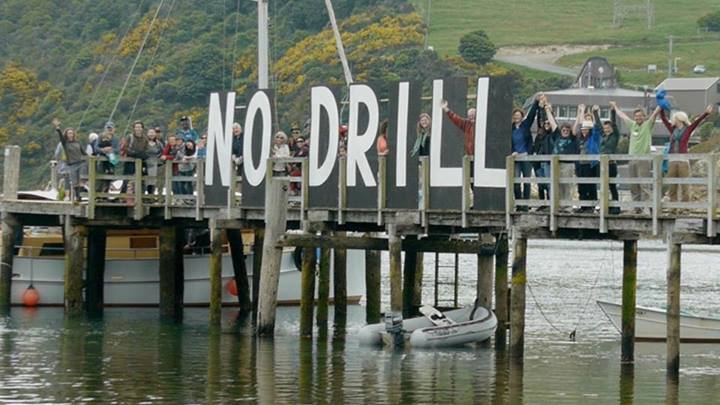
In late October 2013 the St Martin Island Community Inc erected a NO
DRILL sign on our jetty on Quarantine Island, Otago Harbour. The sign
was provided by Oil Free Otago on our request after we initiated a
meeting between the two groups.

On the 10th January 2014 we were issued with an abatement notice from
the Otago Regional Council to remove the NO DRILL signage from the jetty
on Quarantine Island. We are appealing this abatement notice.

In the abatement notice ORC state that the signage is advertising and
that the coastal permit for the jetty does not allow this, but SMIC
believe the signage provides a prudent safety message.

The RMA legislation is effects based – this signage is all about
reducing our environmental effects’ SMIC spokesperson Francine Vella said.

The St Martin Island Community have lodged an appeal against the
abatement notice with the Environment Court.

Francine Vella on Behalf of the St Martin Island Community Inc,
Quarantine Island, Otago Harbour.

Welcome Home, Flotilla!

Video Blog 29: The Homecoming
The Oil Free Seas Flotilla are back on land. Watch and see what they have to say!

OFO/DCC Submission to Petroleum Block Offer 2014

Otago Harbour

Otago Harbour

Oil Free Otago’s submission to the Dunedin City Council submission to Petroleum Block Offer 2014.
DCC now have until 14 November to correlate residents’ responses and write their own submission. All residents’ submissions will be attached as an appendix which will go to NZ Petroleum and Minerals (NZPAM), which reports to Simon Bridges, Minister of Energy and Resources.

Submission on Petroleum Block Offer 2014 consultation

To the Dunedin City Council

policy@dcc.govt.nz

31 October 2013

From: OIL FREE OTAGO

Email contact details: oilfreeotago@gmail.com

Kia ora

Oil Free Otago acknowledge the government’s commitment to consult with iwi and hapu about Block Offer 2014 and are pleased to accept the mana whenua’s important role as Kaitiaki of the coast and ocean on behalf of us all. However, we do not accept that other residents will not be consulted. Even local authorities are not being consulted, but onlynotified to ensure an informed and robust process“. This is not acceptable.

The risks to Dunedin (and in the wider context to all New Zealanders and to the world) of deep sea drilling off the Otago coast and anywhere in our exclusive economic zone are so serious that we recommend that all deep sea exploration and drilling in NZ should cease. The two major risks are local, to the environment and the economy and global, to climate change.

Environment and economy 

A major gas blowout or oil spill has the potential to ruin Dunedin’s environment and economy, due to its effect on: 

Our Otago coast’s clean unspoilt beauty, its unique wildlife and the special lifestyle it affords (surfing, diving, boating etc) – and on the importance of NZ’s 100% pure clean green brand.

Dunedin’s ecotourism which brings around $100 million annually into our local economy. Wildlife that would be affected includes:

yellow eyed penguins

Northern royal albatross (more albatross species breed in our exclusive economic zone than anywhere else in the world)

world’s rarest sea lion, the NZ sea lion

38 of the world’s 80 whale and dolphin species breed here. Whales are returning to the Otago coast after many years’ absence.

The fishing industry – commercial, recreational and customary. Fishing is New Zealand’s fifth largest industry, generating $1.2 – 1.5 billion per year. The fishing industry in the Gulf of Mexico may take 50 years to recover from the Deepwater Horizon disaster – if ever. (John Wathen http://www.youtube.com/watch?v=yduv3APYawA)

Rather than being an economic boon as many suggest or believe, the industry is an economic and social burden. 

The oil and gas industry has already cost taxpayers $46 million this year. (http://awsassets.wwfnz.panda.org/downloads/wwf_fossil_fuel_finance_nz_subsidies_report.pdf)

We could not afford a disaster. The Deepwater Horizon disaster cost Americans $42.2 billion. (wikipedia)

Jobs will not be for local people – they will be specialist positions for foreign or out of town experts (http://www.med.govt.nz/sectors-industries/natural-resources/pdf-docs-library/oil-and-gas/economic-contribution-of-oil-and-gas-industry/BERL%20report.pdf)

Infrastructure costs, for example improving Dunedin airport for larger industry traffic, would likely fall upon the ratepayer and taxpayer with no regional royalties from the industry.

Concern of the social impact of a large extractive industry offshore – what effects will fly-in fly-out workers have on our safe Dunedin social fabric?

It is economically naive to invest money and energy in exploring for and producing a product that must not be used due to climate change (see below). For our local community to depend on oil or gas for its wellbeing makes no economic or social sense whatsoever (eg: Environmental Debt, Amy Larkin, 2013 p150)

Anadarko were a 25% co-owner of the Deepwater Horizon disaster and received daily reports of events leading up to that disaster. It appears they were not a passive investor as asserted by NZ’s Anadarko CEO on Campbell Live 8 October 2013. This assertion and other incidents, such as a US class actions against them, the Anadarko NZ companies being registered in the Cayman Islands (why, if not to avoid paying income tax?), their lack of transparency whilst visiting Dunedin and their use of military counterinsurgency tactics against US citizen industry activists (http://dfw.cbslocal.com/2011/11/11/gas-companies-caught-using-military-strategies-to-overcome-drilling-concerns/) do not paint Anadarko as a trustworthy corporate citizen yet we are being asked to trust them with our ocean and livelihoods. Is this the type of company we should invite to Dunedin?

The risky nature of deep sea drilling in the New Zealand context

The treacherous southern ocean environment – weather extremes, ocean currents from the Antarctic, huge swells as high as six story buildings. (http://www.greenpeace.org/new-zealand/en/reports/Out-Of-Our-Depth-Deep-sea-oil-exploration-in-New-Zealand/)

The distance from help. Relief rigs, if available at all, could be months away and capping devices, the closest of which may be in Singapore, would take at least two weeks to get here. (evidence presented by Shell at August 2013 consultation meeting)

The inadequacy of our Maritime NZ response unit – three “tinnies” with no subsea response capacity.

The government’s use of Corexit. The government has not ruled out using Corexit in the event of a disaster. It used Corexit for two weeks after the Rena oil spill. Corexit is a known carcinogen that has been banned in European countries. It must be banned here and not used again as an oil spill response tool.

Risk data put forward by companies such as Anadarko is historical and not relevant to the untried conditions of our southern ocean.

Climate Change

New Zealand, along with many other countries, has agreed to limit global warming to two degrees, yet its policies contradict this agreement. In order to meet its obligation to the world community and to future generations, 80% of already discovered burnable carbon (oil, gas and coal) must stay in the ground. To stay below the two degree limit all coal must be phased out by 2030, there must be no more drilling for polar or deep sea (marginal) oil and gas, and the remaining conventional oil and gas must be used to urgently build up the infrastructure needed for a low carbon future. (ref: Professor Bob Lloyd, University of Otago, September 2013) It is therefore irresponsible at this time to drill for more, marginal, deep sea oil or gas in dangerous frontier regions such as our southern ocean.

DCC’s submission to last year’s 2013 Petroleum Block Offer recognized the cost to communities of adaptation and mitigation of effects of climate change, and recognised oil and gas’s contribution to climate change but did not appear to join the dots. Governments and local authorities have a duty of care to their citizens. To endorse deep sea drilling off our coast is to disregard this duty.

Alternatives

Climate change mitigation and adaptation measures must match the seriousness of the issue. National and local leaders no longer have the luxury of ignorance nor of failing to join the dots. If we are to take the experts at their word, a ‘wartime response’ to climate change will be needed to keep global warming to a level that will allow for the survival of future Dunedin citizens. Fortunately, we have the ability to make the changes needed in Dunedin and with courage from our leaders could achieve it. Changes are already being made, as proposed in much of the DCC Energy plan, such as making Dunedin a more cycle-friendly city. We have the know-how for an electric car conversion industry to begin immediately to convert Dunedin’s transport fleet. We must encourage local food and low carbon industries such as the electric tram, trains and make public transport affordable and attractive to use. We must stop burning dirty, polluting lignite and coal in our boilers and homes. And again, we recommend that all deep sea exploration and drilling in NZ should cease. There is no time to waste.

Deep Sea Drilling – A Local Perspective

This summer Anadarko Petroleum Corporation intends to begin exploratory deep-sea oil drilling in the Canterbury Basin, off the coast of Otago. Shell are also currently considering deep-sea drilling in the Great South Basin, and using Dunedin as a base. This film gives the perspective of several local academics and prominent members of the community. It addresses the economic, environmental and social issues involved with deep sea drilling off the coast of Otago.

Deep Sea Drilling off Otago – Worth the risk?

We say – oil or gas – the risk is not worth it. Why?

white-capped-albatross (1)

White-capped albatross after Rena oil spill, Tauranga Photo from http://www.birdlife.org

The risk is ours

  • The oil companies cannot eliminate the risk of a disaster. A disaster like the Gulf of Mexico Deep Water Horizon catastrophe would ruin New Zealand’s south eastern coastline.
  • The cost falls to us – the industry does not have to pay any bond to cover liability.
  • The Rena cost New Zealand taxpayers $36.8 million, and that was tiny compared to a major oil rig blowout. The Horizon disaster in the Gulf of Mexico has cost Americans $80 billion so far.

Jobs and prosperity do not stack up

  • Per dollar earned, the oil industry creates fewer jobs than most other industries, and most of those jobs will come from outside the region.
  • Floating Production, storage and offloading vessels (FPSOs) and Floating Liquid Natural Gas vessels (FLNGs) would take the fuels directly to export. No onshore facilities would be built – so no cheap oil or gas for us. Onshore facilities would be limited to some maintenance and repair work and some support services like hotels, casinos and a helicopter (although we have already heard they would use Nelson for a helicopter service).

We have too much to lose

  • Our ocean is unspoilt and unique. More albatross species breed in our exclusive economic zone than anywhere else in the world.  38 of the world’s 80 whale and dolphin species live in our southern ocean.
  • Whales are returning to our coast after many years’ absence. Planned offshore drilling sites coincide with their migration routes.
  • Tourists, including cruise ship passengers, come to Dunedin for the wildlife harbour cruises, the albatross and yellow-eyed penguin tours.  These businesses have everything to lose if there is an oil or gas spill.
  • Fishing is New Zealand’s fifth largest export earner. An oil spill or gas blowout in our ocean could destroy our commercial, recreational and customary fishing. The Gulf of Mexico’s fishing industry could take 50 years to recover from the Horizon disaster – if it ever recovers.

We have no say

  • We have had no say in whether or not Anadarko and Shell drill in our oceans. Beyond 12 km these companies don’t have to produce ESHIAs (environmental, social and health impact assessments).
  • Neither local tourism operators, fisheries and wildlife experts, nor businesses – whose livelihoods depend on our ocean, our clean green image and our abundant natural fauna – have had input into the decision to drill.

Burning oil & gas releases CO2, causing climate change

  • Two degrees of global warming is now inevitable – the so-called ‘safe’ limit that world governments have agreed to. Beyond two degrees the climate will become increasingly unstable.
  • Shell, Anadarko and the other fossil fuel companies already have enough discovered reserves on their books to push global warming to five times beyond two degrees.
  • 80% of those reserves have to stay unburned for global warming to keep to two degrees. Anyone can see that exploration for more oil and gas in such a risky environment is – at the very least – a poor  investment choice.

We do not need to take that risk. We have what it takes right here to develop a low carbon economy

  • With over 70% electricity generated from renewable sources New Zealand is in an enviable position. We can thrive on clean energy and remain true to the values of being an unspoilt place.
  • Dunedin has the expertise to build a low carbon economy that we can bequeath to the next generations. With foresight and leadership from the business community and elected representatives, we can show the way.
  • We are already locked in to a future of rising seas, increased storm surges and changing weather patterns. We can avoid making the future harder by beginning now to improve public transport, electrify our transport fleets, protect low lying areas, consolidate and encourage local food producers, and develop new renewable industries. There are opportunities for everyone.

oil versus gas

  • Anadarko and Shell say they are more likely to find gas than oil off our shores. They are trying to brand gas as the “clean” fossil fuel.
  • Gas still causes global warming. Burning gas releases about 75% the greenhouse gas emissions of crude oil, causing the same damage to the climate in 4 years that oil does in 3.
  • A gas blowout can be a major disaster. In 2012 in the North Sea, an Elgin platform gas leak spewed 200,000 cubic meters of gas per day. It cost $3 billion and took six months to drill relief wells to stop the leak. If this happened here, the oil companies admit it would take months for a relief well to reach NZ.
  • Gas condensate can still wash up on beaches and is toxic to wildlife and humans.
  • Accidental methane emissions from gas wells can be huge and are not factored in to Anadarko and Shell’s definition of a “clean” fossil fuel. Unburned gas from these emissions is mostly methane, which is 21 times more potent at warming the atmosphere than carbon dioxide – nothing “clean” about that.

Taiaroa Head  DSC01807 3 10 0 360

White capped albatross off Taiaroa Head, near Anadarko’s planned drill site. Photo by Derek Onley

Beach Cleaners Protest Shell

fui 3

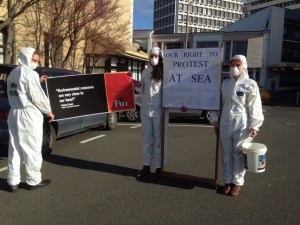
Oil Free Otago staged a ‘beach cleaner’ protest outside Community House on Thursday, where Shell Oil were meeting with environmental groups about their plans for drilling off our coasts in the Great South Basin.

This meeting was part of Shell’s campaign to legitimise their claim that “Environmental concerns are very close to our heart.” To this, we say “Fui”, something Dave’s nana used to say to mean “bullshit”. Shell have a terrible safety and environmental track record. For example, Shell spilled nearly 14,000 tonnes of crude oil into the creeks of the Niger Delta in 2011, they have also recently had to cancel their plans to drill for oil in the Arctic this year.

Our first objective for the day was to engage with members of the public to make them aware of the deep-sea oil risk that is being posed to our coasts. We had an overwhelmingly positive response, with many members of the public joining us in protest for various periods of time.

It was our goal to ensure that Shell is aware that they, and any other oil companies, are unwelcome to drill off the coasts of Otago. We achieved this by, very ‘vocally’, escorting’ the Shell representatives to their car (which we noted was parked in the Countdown carpark, rather than in legal pay-and -display parking 😉  ). They were certainly in a hurry to leave.

Fui 1

Derek Onley, who attended the meeting on behalf of  the  Ornithological Society, said,

“There was little new information.Shell have back-pedaled on their ’empty-ocean’ stance, and are now accepting that yes, the ocean is full of creatures. In fact, they now agree that their drill site is in the middle of a whale migration zone. They mentioned that if there was an oil blow out, it would take relief response at least 14 days to arrive here from Singapore.”

fui 4

Shell said that they have still not decided whether or not they will go ahead and drill.

Oil Free Otago will continue to oppose Shell and Anadarko at every step of the way.

http://www.odt.co.nz/news/dunedin/267143/oil-free-otago-protests-outside-meeting

  fui 2

Eye-Witness Account of The Gulf Of Mexico Oil Disaster

John Wathen is an award winning photo journalist who recently toured Aotearoa recounting his experience both on the ground and in the air documenting the catastrophic 2010 oil spill in the Gulf of Mexico.

John flew out over the gulf in a light plane and captured the event as it was unfolding resulting in some amazing footage and images of the worst environmental disaster in America’s history.

His presentation contains some blunt warnings and important lessons for New Zealand as we consider the threat of deep sea oil drilling in our waters in the near future.