Oil Free Otago comment on “Waipori Fund – Ethical Investing”. Submission to DCC Draft Annual Plan 2014-15

The council should exclude direct and indirect investment in all companies whose main business is the extraction of fossil fuels.

By doing so, Dunedin would be joining 24 cities in the US: Seattle WA, San Francisco CA, Portland OR, Eugene OR, Berkeley CA, Richmond CA, Santa Monica CA, Boulder CO, Santa Fe NM, Madison WI, Bayfield WI, State College PA, Ithaca NY, Truro MA, Provincetown MA, Providence RI, Cambridge MA, Northampton MA, Ann Arbor MI, Boxtel NL, New London CT and Amherst MA.

Worldwide, oil, coal and gas companies have plans to dig up 5 times more CO2 we can afford to burn in order to give ourselves an 80% chance of keeping global warming to 2 degrees C. Investing in fossil fuels is to ignore this truth. It is to willfully ignore the science, which has been clearly enunciated by the latest IPCC report just released, and instead invest in climate change. Investing in fossil fuels makes the Dunedin City Council part of the problem for future generations, rather than being responsible leaders and working towards solutions to this problem.

But it’s not just a problem for future generations; climate change is already having an effect. In Dunedin, as in other coastal communities around the world, the threat of sea level rise and more violent storms is forcing towns and governments to make difficult choices — build higher, build stronger, or retreat. This council already faces these questions for south Dunedin and other areas, and the costs associated with them.

To invest in the fueling of climate change is unethical and irresponsible. Dunedin should instead put its hand up as a solutions-based city like those US cities listed above, divest from fossil fuels and forge the way for other councils across New Zealand to follow.

Divesting from fossil fuels need not mean a financial loss – a number of financial institutions have recently written reports on divestment from fossil fuels and the carbon bubble – you can find a selection of key reports at www.350.org.nz/gofossilfree/resources-for-investment-advisors/Dunedin3

Torea’s Message to Anadarko OFO Flotilla 2014-02-09

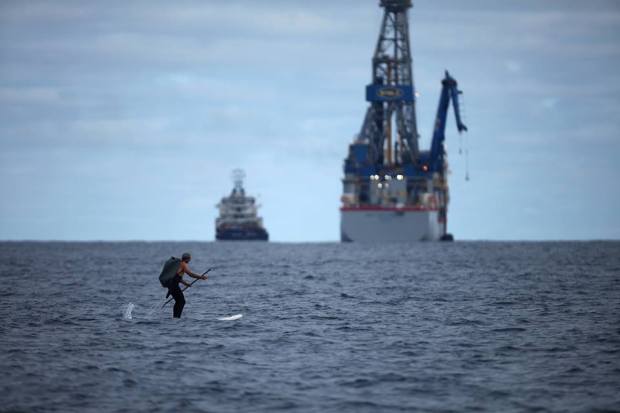
“Tōrea Scott-Fyffe, local Dunedin youth, challenges Anadarko’s Exploratory Drill Shop the Noble Bob Douglas as they arrive at the deep-sea-drilling site off the coast of Otago. Tōrea represents the next generations who demand a liveable future, which is part an clean-energy industry that provides more jobs globally and does not contribute to irreversible climate change.”

(Video 1 of 5 by Richard Simkins)

April Newsletter

Oil Free Seas Flotilla: Barclay with supplies for Flotilla

Oil Free Seas Flotilla: Barclay with supplies for Flotilla

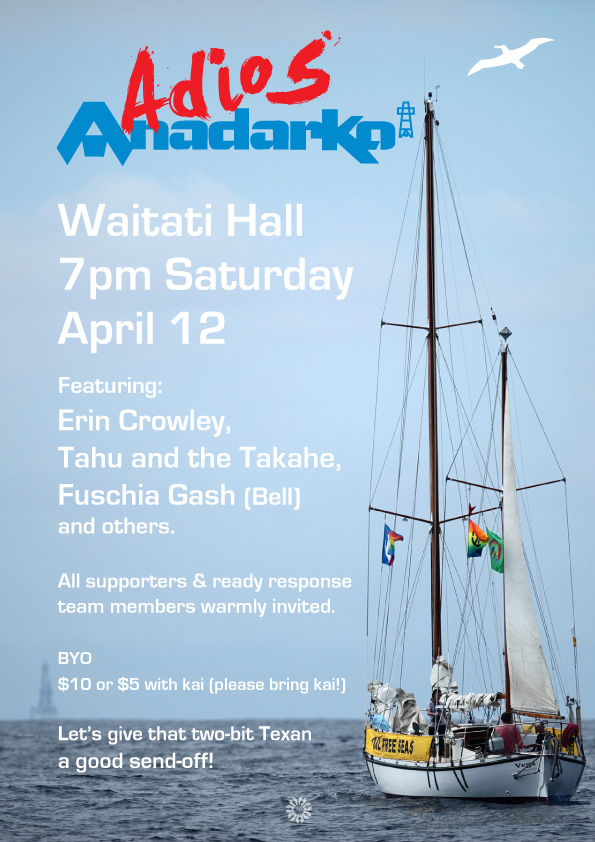
Adios Anadarko!

Schist happens. Anadarko struck it off Taiaroa Head along with some hardrock granite, sand, clay and, as Anadarko have now publicly confirmed, no commercial quantities of oil or gas. For their trouble they clocked up a bill of around $300 million in NZ’s deep ocean.  It was a somewhat inglorious (ignoble) retreat for the Noble Bob Douglas, Anadarko’s hired drill ship, first with an on board leak about the ‘no-find’, and then the ODT reporting selected Dunedin meetings which mysteriously disappeared a day later, but which we now know did occur. Anadarko’s NZ CEO Alan Seay explained how to decipher his announcements this week as reported in the ODT: No Gas but Hunt Goes On. His line a week ago that “detailed laboratory testing would be needed to confirm what had been found” actually means “Nothing found”. Thanks Mr Seay. Now we know. Not only do we have to decipher the usual company spin but also announcements that don’t mean what they say.

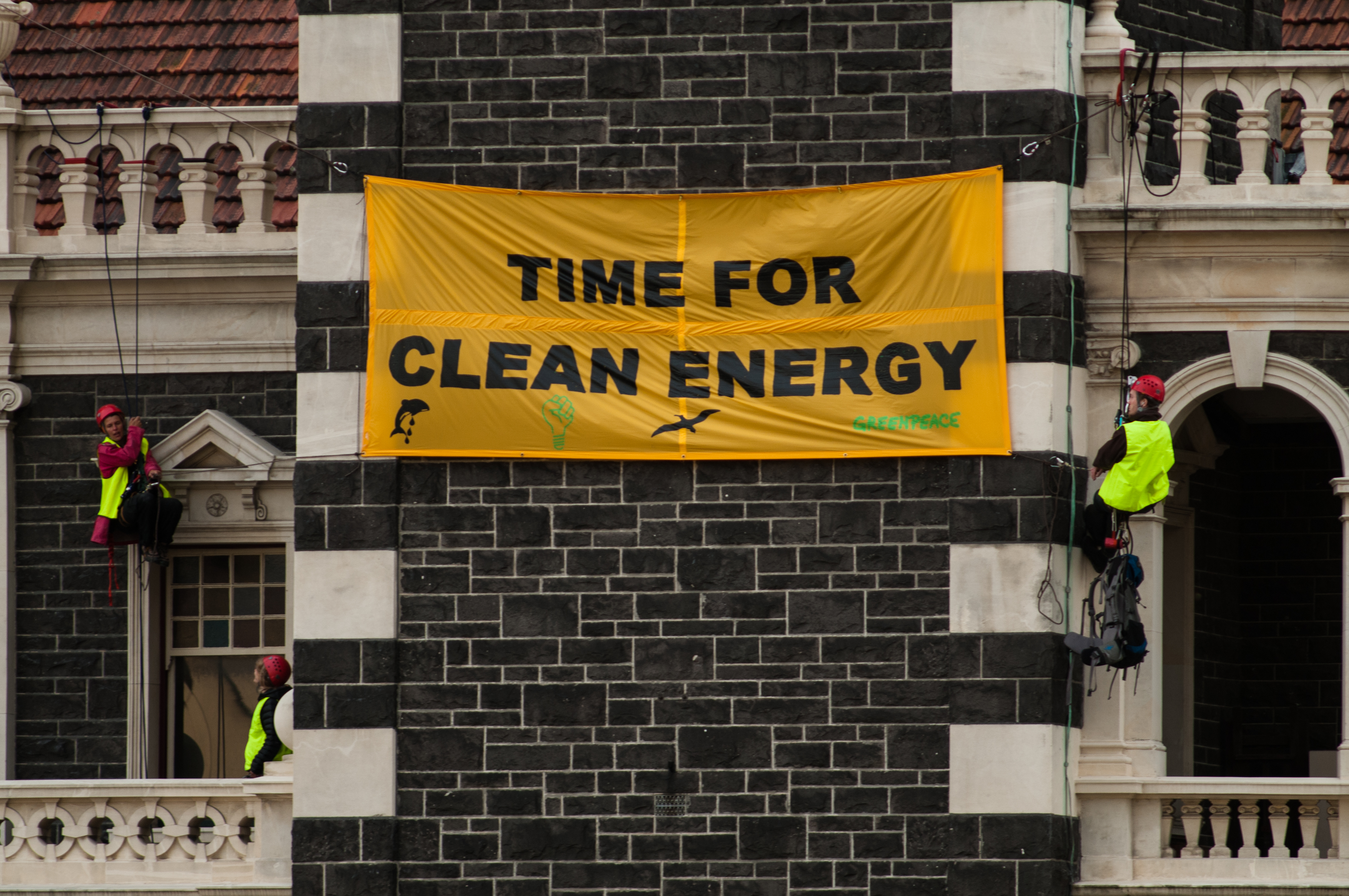
Oil Free Otago’s message to Anadarko, regardless of what they found, is TIME’S UP for deep sea drilling in Aotearoa. It’s time for clean energy!

We hung that message on the Railway Station clock tower last week just to make it clear to the few slow learners in town, and to our backward-looking government. Check the video of the Railway Station Clock Tower Action on YouTube.

The clock tower action, by Oil Free Otago, Oil Free Otautahi (Christchurch), Clean Energy Action (Nelson) and Greenpeace NZ, was on behalf of the many thousands of New Zealanders who came out on their beaches over the summer to say no to Anadarko and deep sea drilling. We’re ready to start our clean energy future now. The transition to renewables is the other side of the same campaign and it’s nice to have the opportunity to shout yes instead of no!

However, there are plenty more ‘NOs’ to come. Don’t take your signs down! Shell’s next…

But first, we’re having an Adios Anadarko PARTY!

Waitati Hall Sat 12 April, 7pm till late.

Featuring Erin Crowley, Tahu and the Takahe, Bell and others.

All supporters and ready response team members warmly invited.

Let’s give that two-bit Texan a good send-off!

If there’s plenty of interest, we’ll hire a bus from town, so get onto Facebook and comment or email us if you’re keen – oilfreeotago@gmail.com

 Shell

Shell’s profits dropped 71% at the end of last year and new CEO Ben van Beurden has made big changes since. Among other things they’ve sold their refinery and retail networks in Australia and won’t be back to the Arctic this 2014 summer. Arctic drilling has cost them $5 billion so far and was “under review” amid negative campaigning from green groups. See? What we do counts!

Shell seem to be putting their money on gas – the ‘clean’ fossil fuel, right…? Wrong. Burning gas releases around 75% the CO2 emissions of crude oil. It’s the filter-tipped cigarette version – does the same damage, just takes a little longer.

Shell have just completed the hull of the largest floating vessel ever built – the FLNG (floating liquid natural gas) vessel, Prelude. It’s a monster – over 4 football fields long, capable of flushing 50 million litres of sea water per hour to liquefy the gas at -162 degrees Celsius. It’s designed to work at sea and only very rarely, every 25 years or so, come into port. While Shell have never said they will use this monstrosity in the GSB this is the very type of frontier region it is designed for. It pretty much guarantees that Shell’s plans are exactly as they have been hinting, if there was a gas find, and it would have to be massive – no jobs for locals, no local infrastructure, no cheap energy for Otago, all gas found would go straight to export. The New Zealand Herald: Shell to drill in the Great South Basin

With no royalties coming to the regions either, there’s very little in it for us. Oh, except the risk, its direct contribution to climate change and the taxpayer money we have already forked out to the oil and gas industry, $46 million last year.

Shell have been conducting seismic testing in the GSB over the summer and are predicting they will be ready to drill their first exploratory well early in the summer of 2016. We’ll be ready.

NZOG

NZOG (New Zealand Oil and Gas) have also been seismic testing off the coast between Dunedin and Oamaru this summer at an estimated cost of between $8-10 million or $300,000 a day. They say they now have around 18 months of analysis before deciding whether or not to drill. Their CEO Andrew Knight has been in town saying he wants to build trust in the community. This is the man who has just taken the “What Lives Down Under” roadshow into Taranaki schools, marketing the industry to children and calling it science. See our blog More Marketing than Science.

Other OFO News

  • The Otago Regional Council told the St Martins Island community into take down the NO DRILL sign on their jetty, claiming it was advertising. The ORC Regional Plan requires the council to “meet the social, economic and cultural needs of the people and communities of Otago, now and in the future.” Instead the council have caved in to business interests and refused to go to mediation with this small community. The islanders chose to take the sign down themselves on Anadarko’s departure because they are ready for a new message. Their experience with the ORC has made them more determined than ever to continue their work against deep sea drilling and towards a low carbon future for the sake of a stable climate for future generations. They say there will be further action.
  • New Zealand’s first major attempt at deep water drilling has turned out to be a huge waste of effort, while the government’s energy agenda looks more short-sighted than ever. Imagine if just a fraction of the millions spent on looking for more oil and gas went into developing clean energy. As we build up to the 20 September election now is the time to push our message of transition to an oil free future and the missed opportunities of wasting more time on fossil fuel extraction. There’s plenty to do:

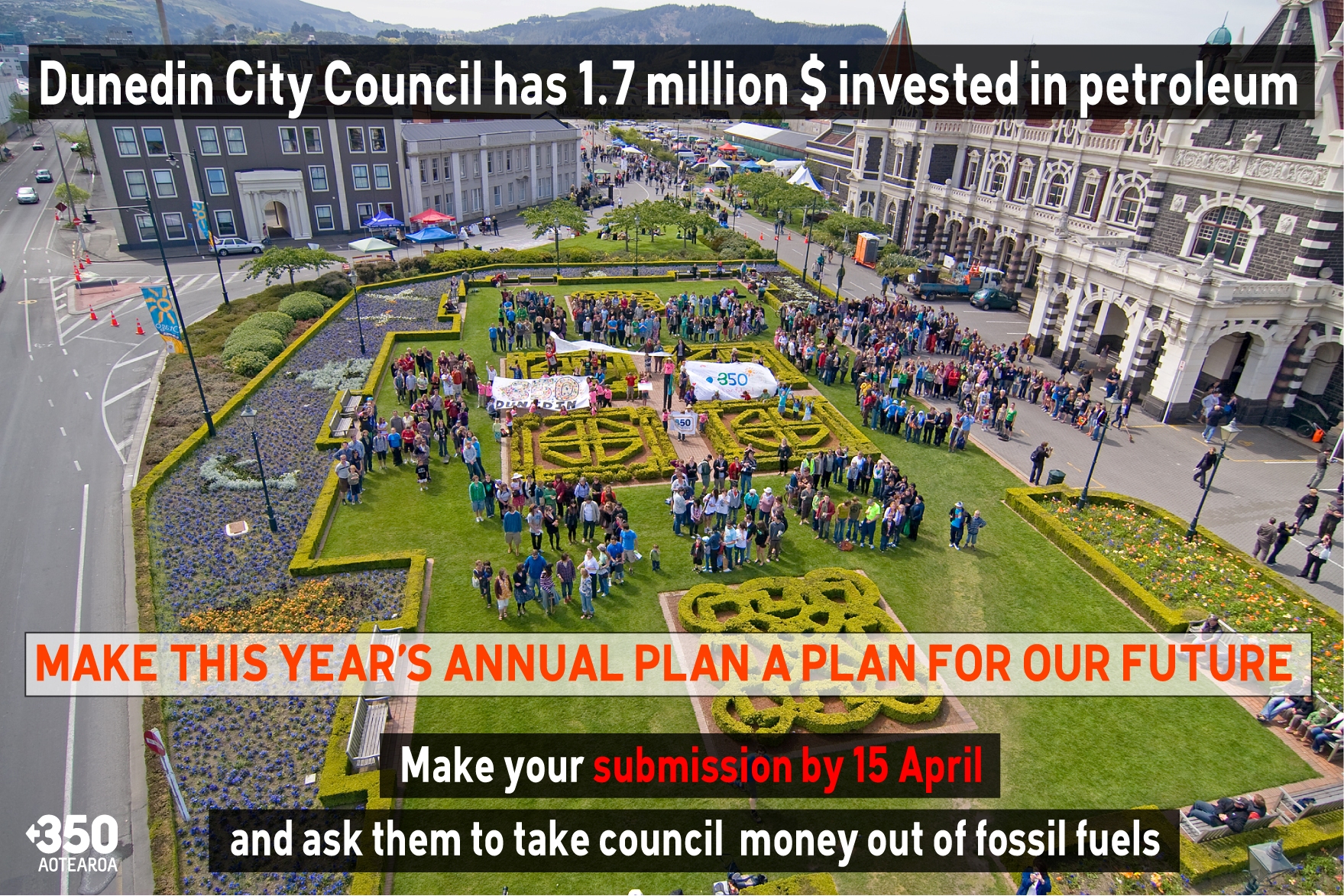
–          Make a submission to the DCC Draft Annual Plan – even if it’s only a few lines – to say your council should NOT be investing in fossil fuels – on line submission form.

–          Join our outreach team, to visit schools, businesses, council etc

–          Join the banner/sign painting team – we’re thinking of some new messages like “Time’s up for deep sea drilling – Clean Energy Now”

–          We are collecting clean energy stories from innovative people and businesses in Dunedin – contact us if you have some to pass on.

–          Keep writing letters to the editor, opinion pieces, on line comments etc. They are having an effect!

–          Donate! We’re a small voluntary group fighting against some of the biggest and richest corporations in the world. We know we can have an effect if we all pull together. If you haven’t got time but can afford to donate, this is a really useful way to help. The Oil Free Otago bank account is:

Oil Free Otago

Kiwi Bank – 38-9015-0104292-00

If you’d like to join our meetings for the next stage of planning, or help in any other way please get in touch: oilfreeotago@gmail.com


Hasta pronto at the party!

OFO Organising Team

Oil Free Otago has been a recipient of a @Radical Action Grant. These Grants support radical grassroots environmental activism – especially climate activism – in Aotearoa. Aimed at groups less able to access conventional sources of funding, the grants go to inspirational and thought-provoking projects that work on a shoestring budget. If you’d like to donate to Radical Action Grants to support other awesome groups, here’s the donate page.
 

Adios Anadarko!

Adios Anadarko poster final copy

It’s party time! We are delighted to celebrate the departure of Texan giant Anadarko’s drill ship, Noble Bob Douglas, from our shores. They left empty handed – a huge win for the climate, our oceans and our campaign. Anadarko left with a very strong message from New Zealanders that we don’t want them here.
It’s been a busy summer with flotillas, summits, protests on the beaches and non-stop campaigning alongside the other oil free groups up and down the country. Our Ready Response unit made the news big time!
Now with the election looming it’s time to highlight the stupidity of the government’s fossil fuel agenda and bring in leaders who will make the transition to a lucrative green economy.

But don’t take down your signs, there’s plenty more campaigning to come with Shell and others on the horizon and the new block offers just announced. But for now, let’s take a night off to celebrate local resistance to deep sea oil and to look forward to a positive year ahead and our next win!

ADIOS ANADARKO! Don’t come back now, hear?

Guest Post: Is the “Aberdeen of the South” an idea past its time?

Is the “Aberdeen of the South” an idea past its time?

Guest post by Professor Colin Campbell-Hunt

colin pic

There are very many of us in Dunedin who will want to welcome Shell and the promise of economic activity that exploration brings. If I were to look ahead only 10 years I might be one. But I have learned a thing or two about oil and gas in the last few years that would urge caution. This is an industry that only has a decade or so of growth left, so if we want our city to invest in infrastructure for industries that will secure our prosperity for the future, oil and gas exploration should be well down the list. Here’s why.

First, even the short-term benefits may be much less than we might think. A 2012 study by the economic consultancy BERL concludes that the prime contractor for engineering and construction would be a large offshore-based multinational. Some sub-contracting work may come to local New Zealand firms, but BERL concludes that few New Zealand companies outside of Taranaki have the expertise required to win contracts for the work.

Second, the same BERL study concludes that the number of sustained jobs created for the local economy would settle at around 200 following a spurt of up to 1,000 jobs during a three-year development phase. It is unlikely that the oil or gas produced would come ashore; more likely it would be shipped directly from a sea-based platform.

So far, the project looks to make reasonable sense, both for Shell, and for Dunedin. But look out beyond 2020 and the horizon looks a lot darker for the oil industry.

The third – and far more serious concern – arises from the effect on the planet’s climate of burning fossil fuels and releasing carbon dioxide CO2 and other greenhouse gases into the atmosphere. Climate modellers at the Potsdam Institute in Germany estimate that if we put another 500 billion tonnes of CO2 into the atmosphere beyond 2013 levels, we would face a one-in-four chance of the planet warming by more than 2C. And if we were to increase that to 1,000 billion tonnes, the chances rise to 50:50.

So how much CO2 is there for us to burn? A 2013 study by the Grantham Institute at the London School of Economics reports that the world’s current proven reserves already contain between 3 and 6 times more CO2 than we could safely throw into the skies. Corporate oil alone has more than enough reserves to blow out the 500 billion tonne budget.

Why does the 2C limit matter? Beyond 2C, science warns that we open ourselves to the possibility of runaway climate change wreaking serious havoc to the world’s population, economy, food supply and political stability. These are not the wild imaginings of prophets of doom who would urge us to climb up a hill somewhere and wait for the world to end. These are level-headed assessment of risks that the human (and non-human) populations of earth are facing right now.

So where is this going to leave the oil industry? At the present rate of emissions, we will hit the 500 billion tonne warning sign in just ten years. If we wanted to keep our chances of avoiding more radical change to just 1-in-4, that would have to be the end of CO2 emissions – not another tonne, ever. Of course that is not going to happen. We are riding on a super tanker that is going to take years to bring to a halt, and this is something that is increasingly accepted – with dismay – by the people who follow these trends. The fact that the oil industry is willing to invest in exploration for new sources of hydrocarbon when we already have far more than we should ever burn tells us that they don’t believe the political will to change our ways will stiffen up any time soon. Which in turn tells us that we, the voters, want to keep our good life for as long as we can too.

But spool forward 10 years, or twenty. The pressures of climate change are only going to get stronger; the realisation of the risks we are running can only get firmer; the prospect of controls being placed on the burning of CO2 can only get greater. A far-offshore gas field is expected to have a life of 35 years. If we are beginning to understand the dangers of climate change now in 2014, we can be very sure they will have radically changed the rules for the oil industry by 2060.

So should Dunedin hitch its economic wagon to this dying industry? Should we be building the public infrastructures to support an industry that has such a poor long-term future? Should we be anxious to attract a business that might deliver 1,000 jobs for three years, then only a quarter of that for however many years it takes before expensive deep sea gas wells get shut down – if indeed they are ever put into production?

There has to be a better way. Developing assets – both physical and human – for the city’s infrastructure to be ready for a low-carbon economy and low-carbon lifestyles will give us a far greater chance of delivering benefit over their productive life than any investments we may be tempted to devote to a dying oil industry.

Colin Campbell-Hunt is a Professor in the University of Otago Business School and has written widely on New Zealand’s competitiveness.

Clock tower climb: Time for clean energy in Dunedin

Oil free and clean energy campaigners from around the country deploying a banner from the Dunedin Railway Station clock tower. The action comes as Anadarko’s drillship, the Noble Bob Douglas, leaves for the Gulf of Mexico after failing to discover any ‘significant’ oil or gas reserves off the coast of Otago. The banner message “TIME FOR CLEAN ENERGY” highlights the need for the government to invest in clean energy projects instead of deep sea oil and gas drilling.

Oil Free Otago spokesperson Rosemary Penwarden stands in front of Oil free and clean energy campaigners from around the country deploying a banner from the Dunedin Railway Station clock tower. The action comes as Anadarko’s drillship, the Noble Bob Douglas, leaves for the Gulf of Mexico after failing to discover any ‘significant’ oil or gas reserves off the coast of Otago. The banner message “TIME FOR CLEAN ENERGY” highlights the need for the government to invest in clean energy projects instead of deep sea oil and gas drilling.

Oil free and clean energy campaigners from around the country deploying a banner from the Dunedin Railway Station clock tower. The action comes as Anadarko’s drillship, the Noble Bob Douglas, leaves for the Gulf of Mexico after failing to discover any ‘significant’ oil or gas reserves off the coast of Otago. The banner message “TIME FOR CLEAN ENERGY” highlights the need for the government to invest in clean energy projects instead of deep sea oil and gas drilling.

Oil free and clean energy campaigners from around the country deploying a banner from the Dunedin Railway Station clock tower. The action comes as Anadarko’s drillship, the Noble Bob Douglas, leaves for the Gulf of Mexico after failing to discover any ‘significant’ oil or gas reserves off the coast of Otago. The banner message “TIME FOR CLEAN ENERGY” highlights the need for the government to invest in clean energy projects instead of deep sea oil and gas drilling.


Press Release: Clock climb kicks-off clean energy countdown

Today oil free and clean energy campaigners from around the country have deployed a banner from the Dunedin Railway Station clock tower. The action comes as Anadarko’s drillship, the Noble Bob Douglas, leaves for the Gulf of Mexico after failing to discover any ‘significant’ oil or gas reserves off the coast of Otago.

Oil Free Otago spokesperson Rosemary Penwarden said “Regardless of Anadarko’s findings in New Zealand, our message remains the same. If we’re serious about climate change we have to stop burning fossil fuels, not keep looking for more. The stone age didn’t end because they ran out of stones, but because innovative, smarter alternatives were found.”

The campaigners say the banner message “TIME FOR CLEAN ENERGY” highlights the need for the government to invest in clean energy projects instead of deep sea oil and gas drilling. The group is made up of representatives from Oil Free Otautahi (Christchurch), Clean Energy Action (Nelson) and Greenpeace NZ.

Greenpeace Climate Campaigner Steve Abel said “As Anadarko skulk back to Texas, having failed to find oil, the Government’s mine, drill, frack economic strategy is failing badly. Rather than throwing tens of millions of taxpayer subsidies to foreign oil drillers the Government should be backing our own cutting-edge clean energy industry which can bring thousands of jobs and billions of dollars of value to our economy without risking an oil disaster.”

Clean Energy Action Nelson representative Verena Maeder said “Oil and gas have had their day, now it’s time to turn to clean energy. We have joined together for this action to show the government that we are united in our opposition to deepsea drilling in the seas of Aotearoa.”

NZ taxpayers spent $46 million last year subsidising the oil and gas industry (1). “These are some of the richest corporations in the world” said Siana Fitzjohn from Oil Free Otautahi. “Our government’s dream of economic salvation from oil and gas shows a complete lack of imagination. We should be spending that money on clean energy instead.”

Ms Penwarden said “It really comes down to what kind of future we want for Dunedin and New Zealand. A ‘business as usual’ future that leaves us at the mercy of foreign oil giants and locks us into being part of the climate change problem, or a future where we lead the world in providing the solutions. It’s time for a cleaner, smarter future and Dunedin could lead the way.”

END

1.http://awsassets.wwfnz.panda.org/downloads/wwf_fossil_fuel_finance_nz_subsidies_report.pdf

More Marketing Than Science

rodshow

Opinion piece by Rosemary Penwarden, published in the Wanganui Chronicle.

What kid doesn’t love dinosaurs? A big black dinosaur truck parks in the centre of town and smiling young people offer free bottled water and sign you up for some fun stuff.

You get your own ID card, swipe it at each display and are welcomed personally to learn about science. How exciting to learn that the exhaust fumes coming out of dad’s car used to be a dinosaur.

Only they didn’t. And it’s not science.

Fossil fuels were not formed from dinosaurs and most of the fossil fuels in the Taranaki region, where this truck has been touring, were laid down in the Cenozoic period after dinosaurs became extinct around 65 million years ago. Taranaki’s oil and gas is produced from decayed plant material, not dinosaur carcasses.

There is some science in the truck and some of the exhibits, along with the truck itself, are hired from the National Science-Technology Roadshow Trust, which New Zealand Oil and Gas (NZOG) sponsors to the tune of $50,000 a year and which has been travelling around New Zealand schools since 1990.

To any unsuspecting parent – and to the kids – it looks like the same old National Science-Technology Roadshow, but when I visited the “What Lives Down Under?” show in Wanganui, NZOG’s external relations manager John Pagani explained that this roadshow is a joint effort by NZOG, Canada’s TAG Oil and Australian company Beach Energy.

About 900 Wanganui kids visited the truck, and the roadshow is visiting Taranaki schools.

Each display emphasised our need for oil and gas and how safe it is, reinforced with images of sleek, shiny cars, expensive boats and planes. My impression of the displays was that they were done by marketing people, not scientists.

For example, the seismic testing display used a cute picture of a bat to explain the sonar technology. There was no mention, or aural examples, of the seismic explosions that have been shown to harm marine life.

There was a lot missing from NZOG, TAG Oil and Beach Energy’s version of “science”, notably any mention of climate change and the effect on the climate of exploring for and burning more oil and gas.

Why tour Wanganui and South Taranaki? Next year the companies will be drilling an exploratory well, Kaheru, 12km off Patea at a water depth of 20-30m in a previously unexplored part of the South Taranaki Bight just north of Wanganui.

The industry knows it hasn’t always managed its external relations well and this, Mr Pagani said, was a way of “trying to start a conversation”.

Why target children? Why not have a public meeting and explain to the adults what you’re planning? He said public meetings didn’t bring people in, while a roadshow would. It brings the parents, too, and staff were there to answer questions.

A young employee in the truck said she had been a bit concerned about the industry targeting children, but her boss thought public meetings disruptive, so they were going for something positive. Does being positive allow you to alter scientific facts?

It takes roughly six to 10 years for a newly-discovered oil or gas field, like Kaheru, to reach full production and, depending on its size, production might last a further 40 years. By then, around mid-century, most of the children at the roadshow will be taxpaying adults and parents.

By then – according to 97 per cent of the world’s climate scientists – we need to have stopped burning CO2.

If we are to take the science seriously, most of the assets on the oil and gas companies’ balance sheets must remain unburned. Only then, scientists say, is there a chance of preserving a habitable future climate.

Mr Pagani said he does not think it fair, all this talk about the destruction of our children’s future. He thinks there is a wonderful future ahead for them.

I agree but it has to be founded on a truthful understanding of climate science, and on the essential but short-term role of his industry as we transition to a low-carbon future.

As long as Mr Pagani and industry investors continue to push – even to kids – their version of a future more related to increasing profit than reality, there is little hope.

Rosemary Penwarden is a Dunedin grandmother, freelance writer and member of Oil Free Otago.


http://www.nzherald.co.nz/wanganui-chronicle/opinion/news/article.cfm?c_id=1503423&objectid=11212754&ref=rss

A visitor to Dunedin Captures our Banners on the Beach event: Footprints in the sand – taken by the sea, 15.04.2014 Otago Dunedin

Footprints in the sand – taken by the sea, 15.04.2014 Otago Dunedin.

Whose Seas Are These?

Guest Blog
by Rev Dr Peter Matheson
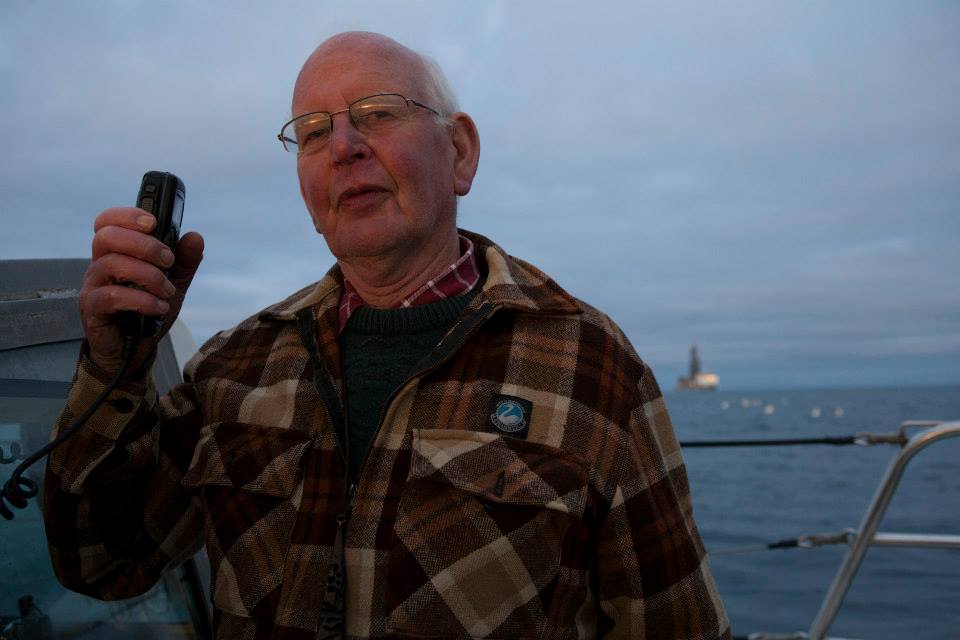
Reverend Doctor Peter Matheson, former lecturer in theology, sends a message to the drill ship the Noble Bob Douglas explaining his opposition to deep sea drilling.  The Oil Free Otago flotilla is a coalition of Otago residents who oppose deep sea drilling off our coast. Photo by Nick Tapp - nicktappvideo.com

Reverend Doctor Peter Matheson, former lecturer in theology, sends a message to the drill ship the Noble Bob Douglas explaining his opposition to deep sea drilling. The Oil Free Otago flotilla is a coalition of Otago residents who oppose deep sea drilling off our coast. Photo by Nick Tapp – nicktappvideo.com

Whose Seas Are These?

Aged 75, I  was  on a yacht for the first time in my life, the heave of the open ocean
beneath my feet.  There were eight of us, soon melded into a team under  Henk, our
charismatic captain:  Brendan a kaitiaki from the Karitane marae, Damien, from Radio
Live, Jeremy, conservation consultant, Niamh,  spokesperson for Oil Free  Otago, Bob,
scientific expert on global warming, and  Ian, a film-maker.  Majestic it felt, heading up
the harbour on full sail,  little groups  on headlands waving placards and cheering us on,
cars  tooting approval. With our sister-ship, the Erewhon, the send-off from Dunedin
Habour reminded us  of the many  environmental, scientific, church, community groups
we represented.
It was misty, quite chilly up top. I was glad of my Swan-Dry.   Our mission was to
confront the drilling-ship, the Noble Bob Douglas, using the sling-shot of words
against this Texan intruder, whose exclusion zone, as Brendan  pointed out, blocked the
traditional passage-way of the waka.  “Whose seas are these?” he asked on
radio-telephone, as  the huge bulk of the drilling ship loomed over us. No answer, of
course.
Good not to live in Putin’s Russia, though.  Our right to protest was respected by
Anadarko.  Yet they appeared to play sneaky games, shutting off their positioning gear,
so we  could not calculate their time of arrival at the drilling site, 65 kilometers off  our
coast.  So we waited  the night out off Aramoana, scene of another successful protest
three decades  ago against that aluminium smelter.
“Whose seas are these?”  Occasionally I’ve seen an albatross or two at the Heads. But
here they were all round the boat, wheeling, soaring, resting on the water, dozens of
them. Petrels, seven other varieties of birds, seals, we even saw two spouting whales.
When eventually the supply boat of the drilling ship bore down on us, a cordon of
toroa,  of albatross sat on the waves as if to protect us. Incredible!   Unforgetable!
Two worlds confronted one another.  The cultivated voice of the American captain
graciously permitted us  to  speak our piece.  First an impassioned address in te reo by
Waiariki, then seventeen year old Toria, hoping desperately her generation would still
have a world to live in (both from the Erewhon), me on the moral challenge, Bob Lloyd
on the insanity of deep sea drilling from a scientific point of view, Niamh, reminding
the intruders of our community support, finally Brendan: “Whose  seas are these?”
“You can’t build a  society on greed”  David Hume, the great Scottish enlightenment
philosopher once said.  “ Sin is bad, but stupidity is irredeemable”, as  Dietrich
Bonhoeffer, appalled by  Nazi Germany put it.   Greed and stupidity  are powering this
drive to Deep Sea  Oil, supported (alas ) by Government, vast financial interests, by the
majority of the media.  Ordinary good, decent  people  still think we can power on as
we are, relying  on  more and more oil.  Yet we only have ten years to dramatically
decrease the carbon emissions, before  we  overrun the  2% increase in global warming,
and  then  we’re  into a truly apocalyptic scenario.  “Woe unto you,” said the Hebrew
prophets.
At heart it’s a question  of  moral authority and whether rationality will prevail.  Whom do
you believe? Anadarko, the Government, have all the power. But do you believe them? Can
you trust them with the lives of our children and children’s children? That is the question
our symbolic protest poses. A dramatic turn-around towards sustainability is the greatest
ethical challenge of our time, and every one of us has the responsibility to rub our eyes,
wake up, and engage with this debate. We’re not asking you to believe us, but to look at the
evidence, face the despair, to overcome it by taking appropriate action. The prayer of those
of us on the Tiama and the Erehwon is that you ask our leaders, with life and death urgency,
to think again.